
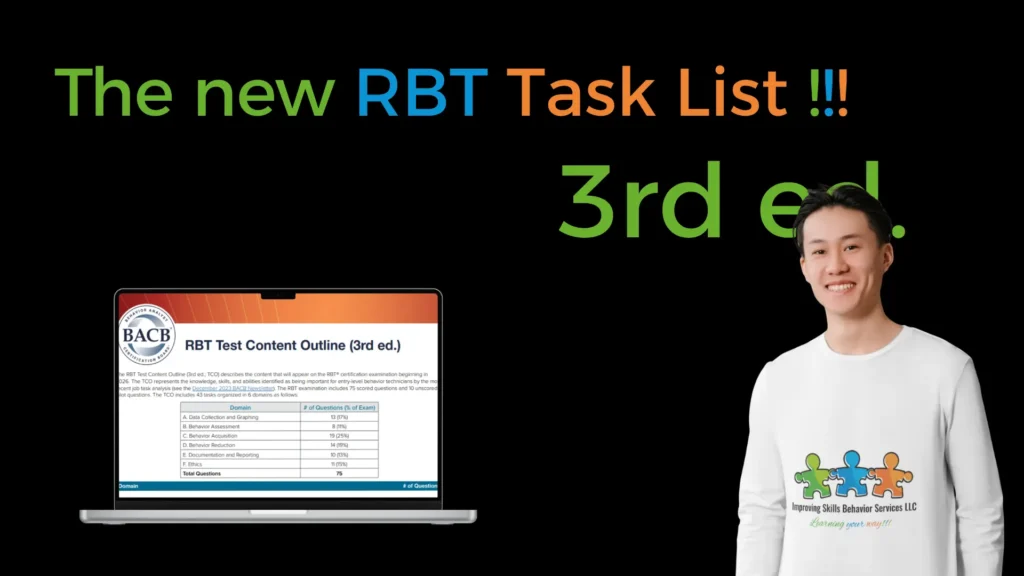
The RBT Test Content Outline (3rd Edition) defines the content that will be assessed on the RBT® certification exam beginning in 2026. This outline represents the knowledge, skills, and competencies required of entry-level behavior technicians, based on the most recent job task analysis in the field of behavior analysis.
The RBT exam consists of:
- 75 scored questions
- 10 unscored pilot questions
The content is organized into six primary domains, each contributing a specific percentage to the exam.
RBT Exam Domain Distribution
| Domain | Number of Questions | Percentage |
|---|---|---|
| A. Data Collection and Graphing | 13 | 17% |
| B. Behavior Assessment | 8 | 11% |
| C. Behavior Acquisition | 19 | 25% |
| D. Behavior Reduction | 14 | 19% |
| E. Documentation and Reporting | 10 | 13% |
| F. Ethics | 11 | 15% |
| Total | 75 | 100% |
Domain A: Data Collection and Graphing
This domain focuses on the ability to accurately collect, record, and interpret behavioral data.
Key Topics:
- Implement continuous measurement procedures (frequency, duration, latency, interresponse time)
- Implement discontinuous measurement procedures (partial interval, whole interval, momentary time sampling)
- Permanent product recording procedures
- Entering data and updating graphs
- Describing behavior and environment in observable and measurable terms
- Calculating and summarizing data (rate, mean duration, percentage)
- Identifying trends in graphed data
- Understanding risks of unreliable data and poor procedural fidelity
Domain B: Behavior Assessment
This domain evaluates participation in behavioral and skill-based assessments.
Key Topics:
- Conducting preference assessments (multiple stimulus, paired stimulus, free operant)
- Participating in skill assessments (curriculum-based, developmental, social skills)
- Participating in functional behavior assessment components:
- Descriptive assessments
- Functional analysis
Domain C: Behavior Acquisition
This is one of the most heavily weighted domains, focusing on teaching new skills.
Key Topics:
- Implementing positive and negative reinforcement
- Using conditioned reinforcers
- Discrete Trial Teaching (DTT)
- Naturalistic teaching strategies (incidental teaching, NET)
- Task analysis and chaining procedures (forward, backward, total task)
- Discrimination training
- Prompting and prompt fading procedures
- Generalization across settings, people, and stimuli
- Distinguishing between maintenance and acquisition procedures
- Shaping procedures
- Token economies
Domain D: Behavior Reduction
This domain focuses on reducing challenging behaviors using evidence-based strategies.
Key Topics:
- Identifying functions of behavior
- Antecedent interventions:
- Noncontingent reinforcement (NCR)
- High-probability request sequences
- Demand fading
- Differential reinforcement procedures:
- DRO, DRA, DRI, DRL, Functional Communication Training (FCT)
- Extinction procedures
- Positive and negative punishment procedures
- Side effects of extinction and punishment:
- Extinction burst
- Response variation
- Resurgence
- Emotional responding
- Crisis and emergency procedures
Domain E: Documentation and Reporting
This domain emphasizes professional communication and accurate documentation.
Key Topics:
- Communicating concerns to supervisors in a timely manner
- Seeking clinical guidance and supervision
- Reporting variables that may affect client progress:
- Illness
- Medication changes
- Schedule changes
- Objective session documentation
- Compliance with legal, regulatory, and workplace requirements
Domain F: Ethics
This domain covers ethical conduct and adherence to professional standards.
Key Topics:
- Core ethical principles:
- Benefiting others
- Treating others with dignity, compassion, and respect
- Acting with integrity
- Providing services within scope of competence
- Working under appropriate supervision
- Effective supervision practices
- Confidentiality and data protection requirements
- Responsible use of public statements and social media
- Avoiding and managing multiple relationships
- Gift-giving and receiving guidelines
- Professional interpersonal skills (communication, collaboration, accepting feedback)
- Cultural humility and responsiveness in practice
Download the new task list
Conclusion
The RBT Test Content Outline (3rd Edition) provides a clear framework of the competencies required for Registered Behavior Technicians. Mastering these domains is essential not only for passing the certification exam but also for delivering ethical, effective, and high-quality services in the field of behavior analysis.